
Appendicitis Treatment in Kadapa: Signs, Causes, Surgery, Recovery & Best Time to Get Help

If you have sudden stomach pain on the lower right side, fever, vomiting, or trouble walking because of pain, it may not be “just gas.” It could be appendicitis.
Many people in Kadapa ignore early stomach pain because they think it will go away on its own. That mistake can become dangerous. A burst appendix can cause a serious infection inside the stomach and may even become life-threatening.
This guide explains appendicitis in very simple words so anyone can understand it — even a child. You will learn what appendicitis is, why it happens, how to identify the warning signs, when surgery is needed, how recovery works, and where to get appendicitis treatment in Kadapa.
What Is Appendicitis?
The appendix is a small finger-shaped pouch attached to your large intestine. It sits on the lower right side of your stomach.
Sometimes the appendix gets blocked and swollen. This swelling is called appendicitis.
When the appendix becomes infected, it causes pain and fever. If doctors do not treat it quickly, the appendix can burst.
Think of the appendix like a balloon filled with pressure. If pressure keeps increasing, it may tear open.
That is why appendicitis is considered a medical emergency.
Where Is Appendicitis Pain Felt?
Most people first feel pain near the belly button. After a few hours, the pain moves to the lower right side of the stomach.
This pain usually becomes worse while walking, coughing, or sneezing. Unlike normal gas pain, appendicitis pain keeps increasing with time and does not improve with home remedies.
Many people in Kadapa search online for terms like “right side stomach pain,” “appendix pain symptoms,” or “best appendicitis hospital in Kadapa.” In many cases, these symptoms are connected to appendix infection. If the pain keeps increasing, medical evaluation should not be delayed.
Common Symptoms of Appendicitis
Appendicitis symptoms usually start suddenly and become worse within a few hours. The most common symptom is pain in the lower right side of the abdomen. Many patients first feel pain near the belly button, but later the pain shifts to the right side.
Along with stomach pain, many people also experience fever, vomiting, nausea, loss of appetite, stomach bloating, or difficulty walking because movement increases the pain. Some patients may also develop constipation or loose motions.
One important thing people should understand is that appendicitis pain usually keeps increasing. Normal gas pain often improves after rest or passing gas, but appendix pain generally becomes sharper with time.
Symptoms of Appendicitis in Children
Children cannot always explain pain clearly.
Parents should watch carefully if a child has stomach pain with fever, vomiting, bending while walking, refusing food, or crying when the lower right stomach is touched. Many parents think it is simple food poisoning or a regular stomach infection. That misunderstanding can delay treatment and increase complications.
Symptoms of Appendicitis in Women
Appendicitis symptoms in women can sometimes feel similar to period pain, urine infection, or ovarian cyst pain. Because of this confusion, many women delay treatment.
If pain continues to increase on the lower right side along with fever, vomiting, or weakness, immediate medical evaluation becomes important.
What Causes Appendicitis?
Appendicitis usually happens when the appendix becomes blocked.
The blockage may happen because of hard stool, infection, swollen tissue, worms, or in rare cases tumors. Once the appendix becomes blocked, bacteria start growing inside it. This leads to swelling, infection, and increasing pain.
Can Appendicitis Go Away Without Surgery?
Some people search:
- “Can antibiotics cure appendicitis?”
- “Can appendicitis heal naturally?”
- “Home remedies for appendix pain”
The truth is simple.
Mild cases may temporarily improve with medicines, but many patients still need surgery later.
Doctors usually recommend surgery because the appendix can burst without warning.
Trying home remedies while the appendix is worsening can be dangerous.
What Happens If the Appendix Bursts?
A burst appendix is very serious.
When the appendix tears open, infection spreads inside the abdomen.
This can lead to pus collection, severe infection, damage to nearby organs, and even dangerous blood infection called sepsis. Patients may develop high fever, extreme weakness, swollen abdomen, and severe pain.
A burst appendix is a medical emergency and requires immediate surgery.
How Doctors Diagnose Appendicitis
Doctors use several tests to confirm appendicitis. During physical examination, the doctor checks where the pain is strongest. Blood tests help identify infection inside the body.
Doctors may also recommend ultrasound scanning or CT scans to clearly see swelling in the appendix. Early diagnosis is very important because it reduces complications and improves recovery speed.
Best Treatment for Appendicitis in Kadapa
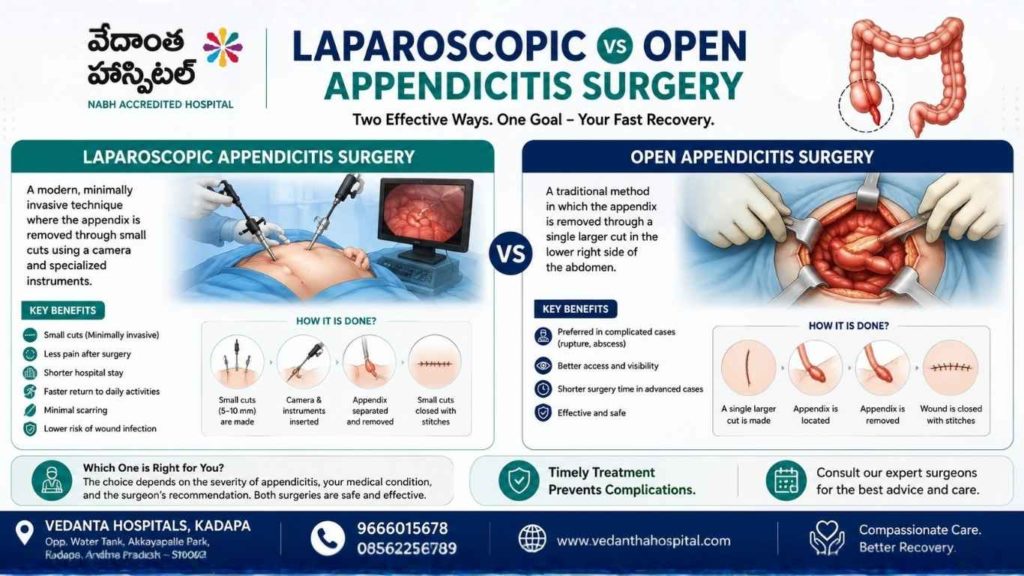
The best treatment for appendicitis is usually appendix removal surgery.
This surgery is called appendectomy.
Doctors perform appendectomy in two main ways.
1.Laproscopic Appendicitis Surgery
This is also called keyhole surgery.
Doctors make very small cuts and use a camera to remove the appendix.
Laparoscopic surgery has become a common choice because it uses smaller cuts, causes less pain, and allows faster recovery. Patients usually have smaller scars, lower infection risk, and shorter hospital stays.
Many patients can walk within hours after surgery and return to normal activities much faster compared to traditional surgery.
2. Open Appendicitis surgery
In severe cases or burst appendix conditions, doctors may perform open surgery.
This requires a larger cut on the abdomen.
Open surgery may be necessary when the appendix has already burst, infection has spread widely, or swelling inside the abdomen becomes severe. In some patients, laparoscopic surgery may not be the safest option.
How Long Does Appendicitis Surgery Take?
Most appendicitis surgeries take around 30 minutes to 1 hour.
However, complicated cases may take longer.
The hospital stay depends on the severity of infection, type of surgery, patient age, and recovery speed. Many patients are discharged within one or two days when treatment happens early.
Recovery After Appendicitis Surgery
Recovery is usually smooth if treatment happens early.
After laparoscopic surgery, many patients start walking on the same day and return to light work within one week. Full recovery usually happens within two to three weeks.
Patients who undergo open surgery may need more recovery time. In such cases, recovery may take three to six weeks along with additional wound care and rest.
Foods to Eat After Appendix Surgery
Doctors usually recommend light foods during recovery.
Doctors usually recommend light and easy-to-digest foods after surgery. Rice, idli, bananas, soup, curd rice, boiled vegetables, and coconut water are commonly advised during recovery.
Patients should avoid oily food, spicy food, junk food, alcohol, and smoking for some time after surgery. Drinking enough water is also important to prevent constipation.
When Should You Go to the Hospital Immediately?
Do not wait at home if you have severe right-side stomach pain, fever with abdominal pain, vomiting, worsening pain every hour, difficulty walking, or swelling in the stomach.
Appendicitis is not a condition that should be ignored for several days. Fast treatment reduces the risk of dangerous complications.
Appendicitis Treatment for Elderly Patients
Older adults sometimes have unusual symptoms.
Instead of severe pain, older adults may only feel weakness, mild stomach discomfort, fever, or loss of appetite. Because symptoms are less obvious, diagnosis often gets delayed.
Senior citizens should never ignore sudden stomach pain because delayed treatment increases complication risk.
How Much Does Appendicitis Surgery Cost in Kadapa?
The cost depends on several factors.
The total treatment cost depends on several factors including the type of surgery, duration of hospital stay, room category, infection severity, insurance coverage, and ICU requirement if complications are present.
Patients should discuss detailed treatment plans and insurance coverage directly with the hospital.
Why Choosing the Right Hospital Matters
Appendicitis treatment is time-sensitive.
A good hospital can provide fast diagnosis, emergency surgery support, experienced surgeons, modern operation theatres, and proper post-surgery care.
Since appendicitis can become dangerous within a short time, many patients prefer hospitals with emergency care facilities and experienced surgical teams.
Final Thoughts
Appendicitis is one of the most common emergency abdominal conditions.
The biggest mistake people make is waiting too long.
If stomach pain keeps increasing, especially on the lower right side with fever or vomiting, do not depend only on home remedies or internet searches.
Early diagnosis and treatment can prevent dangerous complications and help patients recover quickly.
People searching for appendicitis treatment in Kadapa should choose a hospital that offers emergency evaluation, experienced doctors, and timely surgical care.
Vedanta Hospital in Kadapa provides medical evaluation and treatment support for patients experiencing abdominal emergencies and appendicitis symptoms.