
Brachial Plexus Injury Treatment in Kadapa: Symptoms, Causes, Surgery and Recovery
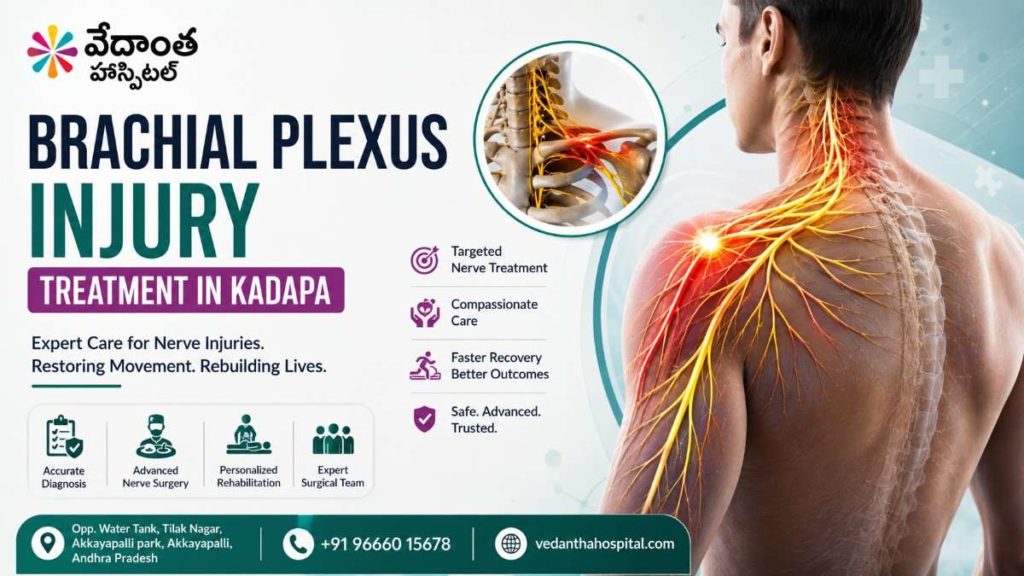
A brachial plexus injury can affect the nerves that control movement and feeling in the shoulder, arm, and hand. It commonly occurs after a road accident, fall, sports injury, or another trauma that stretches or tears these nerves. Mild injuries may improve with time and rehabilitation, while severe injuries may require nerve repair, nerve grafting, nerve transfer, or other reconstructive procedures.
If you are searching for brachial plexus injury treatment in Kadapa, this guide explains what the condition means, its symptoms, how doctors diagnose it, when surgery may be needed, what recovery involves, and why early specialist evaluation matters.
Quick Answer: How Is a Brachial Plexus Injury Treated?
Treatment depends on how badly the nerves are damaged and whether they are stretched, compressed, scarred, partially torn, or completely separated from their normal connection.
Mild injuries may be managed with observation, pain control, physiotherapy, and regular monitoring. More serious injuries may require surgery such as nerve repair, neurolysis, nerve grafting, or nerve transfer. In some advanced or long-standing cases, tendon or muscle transfer procedures may be considered to improve arm function.
The timing of treatment is important because injured nerves recover slowly, and prolonged loss of nerve supply can reduce the ability of muscles to recover.
What Is the Brachial Plexus?
The brachial plexus is a network of nerves that runs from the neck to the shoulder and into the arm.
Think of these nerves like electrical wires connecting the spinal cord to the arm. They carry messages from the brain to the muscles and also send information such as touch, temperature, and pain back to the brain.
The brachial plexus helps control important functions of the:
- Shoulder
- Upper arm
- Elbow
- Forearm
- Wrist
- Hand
When these nerves are damaged, a person may have difficulty moving the arm or may lose sensation in part of the arm or hand.
What Causes a Brachial Plexus Injury?
Trauma is one of the most common causes of serious brachial plexus injury.
A sudden force can stretch the nerves between the neck and shoulder. A stronger injury can partially tear a nerve or completely separate it from surrounding structures.
Common causes include:
- Motorcycle and road accidents
- Falls from a height
- Sports injuries
- Crush injuries
- Shoulder trauma
- Birth-related nerve injuries in babies
- Penetrating injuries
- Tumours or other conditions that put pressure on the nerves
Traumatic brachial plexus injuries are particularly associated with high-energy accidents, including motorcycle crashes. A recent review of published guidelines found that traumatic cases commonly affect younger, economically active people and that delayed diagnosis or treatment can be associated with poorer functional outcomes.
What Are the Common Signs of a Brachial Plexus Injury?
The symptoms can vary depending on which nerves are injured and how severe the damage is.
Some people experience mild tingling or weakness. Severe injuries can cause major loss of movement in the arm.
Common symptoms include:
- Weakness in the shoulder or arm
- Difficulty lifting the arm
- Trouble bending the elbow
- Weak grip
- Numbness or reduced sensation
- Tingling or burning
- Severe nerve pain
- Difficulty moving part of the arm
- A limp or poorly controlled arm
For example, a person may be able to move their fingers but have difficulty lifting the shoulder. Another person with a more extensive injury may have very little movement throughout the arm.
This difference is important because the pattern of weakness helps the doctor understand which parts of the brachial plexus may be injured.
Can a Brachial Plexus Injury Heal on Its Own?
Sometimes, yes.
A nerve that has only been stretched may recover without surgery. The recovery process can take time, and doctors may monitor muscle strength, sensation, and nerve function during this period.
However, a severely damaged nerve may not recover adequately on its own.
A person should not assume that a completely weak or paralysed arm will automatically recover simply by waiting.
This is one of the biggest reasons why specialist assessment is important after a significant injury.
When Should You See a Doctor?
You should get a medical assessment after an accident if you develop persistent weakness, numbness, loss of movement, or severe pain in the arm.
Do not wait for months without evaluation if the arm remains weak after a major injury.
Seek prompt medical attention if:
- You suddenly cannot move your arm
- Your arm becomes very weak after an accident
- Reduced sensation or numbness in the arm or hand
- You develop severe burning or nerve pain
- The shoulder, elbow, or hand stops functioning normally
- Symptoms continue instead of improving
Early evaluation does not automatically mean surgery.
It means identifying the injury early enough to understand whether observation, rehabilitation, or nerve reconstruction is appropriate.
How Is Brachial Plexus Injury Diagnosed?
Diagnosis begins with a detailed medical history and physical examination.
The doctor checks which muscles are weak and which areas have reduced sensation. Reflexes and other nerve functions may also be assessed.
Additional tests may be needed to understand the location and severity of the nerve injury.
Electromyography and Nerve Tests
An EMG and nerve conduction study can help assess how well the nerves and muscles are working.
These tests can provide information about nerve damage and whether signals are reaching the muscles normally.
MRI and Other Imaging
MRI and other imaging studies may help doctors look at the brachial plexus and surrounding structures.
The exact tests depend on the suspected injury and the findings during examination.
Mayo Clinic lists neurological examination, electromyography, and MRI among the investigations used to evaluate brachial plexus injuries.
Why Is the Type of Nerve Injury Important?
Brachial plexus injuries can vary widely in their type and severity.
A nerve can be stretched without being torn. It can also develop scar tissue, partially tear, completely rupture, or in severe cases have its nerve root pulled away from the spinal cord.
The treatment changes depending on the type of damage.
For example, a stretched nerve may recover with time and rehabilitation, while a completely disrupted nerve may need reconstruction.
This is why treatment should be based on proper diagnosis rather than simply treating the symptoms.
Brachial Plexus Injury Treatment Options
The right treatment depends on the severity and location of the nerve injury, how long ago the injury occurred, the patient’s age and general health, and whether there is evidence of natural recovery.
Observation and Monitoring
Some mild injuries can improve naturally.
During this period, doctors monitor whether muscle strength and nerve function are returning.
Regular follow-up is important because the treatment plan may need to change if recovery is not progressing as expected.
Physiotherapy and Rehabilitation
Physiotherapy is an important part of brachial plexus injury management.
Exercises can help maintain movement in the joints and prevent stiffness while the nerves recover.
Rehabilitation may focus on:
- Maintaining joint movement
- Preventing muscle and joint stiffness
- Preserving useful movement
- Improving muscle strength when nerve function returns
- Retraining movement after nerve reconstruction
Physical therapy is also commonly used before and after surgery, although the exact rehabilitation programme needs to be individualized.
When Is Surgery Needed?
Surgery may be considered when the nerve injury is severe or when there is little evidence of useful recovery.
The decision depends on the injury pattern and results of clinical, imaging, and electrodiagnostic testing.
Common reconstructive options include:
- Nerve repair
- Neurolysis
- Nerve grafting
- Nerve transfer
- Tendon transfer
- Muscle transfer
Not every patient needs all of these procedures.
The goal is to restore useful function, such as shoulder stability, elbow bending, wrist movement, or hand function, depending on which nerves have been damaged.
What Is Nerve Repair?
Nerve repair involves reconnecting the damaged ends of a nerve when this can be done directly.
This may be possible when the injury has created a clean separation but enough healthy nerve remains for the ends to be brought together.
The surgeon uses microsurgical techniques to carefully reconnect the nerve.
The repaired nerve then needs time to regenerate
What Is Nerve Grafting?
Sometimes the damaged section of the nerve is too long to reconnect directly.
In these situations, a healthy nerve may be taken from another part of the body and used as a bridge between the damaged nerve ends.
This is called a nerve graft.
Think of it like replacing a damaged section of an electrical wire with a new section that connects the two ends.
Nerve growth is slow, so improvement does not happen immediately after surgery.
What Is a Nerve Transfer?
A nerve transfer uses a functioning nerve or nerve branch and connects it to a damaged nerve to help restore useful movement.
This technique can be particularly useful when the original nerve cannot be repaired directly.
Nerve transfers are used in selected severe injuries, including some injuries involving nerve-root avulsion. They can also be used to help restore specific functions such as elbow movement or shoulder function.
Modern reviews describe nerve transfer as an important reconstructive option for both complete and partial brachial plexus injuries.
What Is Neurolysis?
Sometimes a nerve remains connected but becomes surrounded by scar tissue.
Neurolysis is a procedure used to free the nerve from scar tissue.
Whether neurolysis is useful depends on the condition of the nerve and the findings during evaluation.
It is not automatically the right treatment for every patient.
What Happens If the Injury Is Very Severe or Treatment Is Delayed?
Severe or long-standing brachial plexus injuries can be more difficult to reconstruct.
If the muscles have been without useful nerve signals for a long time, restoring the nerve alone may not always restore normal function.
In selected cases, surgeons may consider tendon transfer, muscle transfer, or other reconstructive procedures.
The goal may be to restore useful movements rather than completely normal arm function.
This is an important expectation to understand: brachial plexus surgery can improve function, but it cannot guarantee a completely normal arm.
Published reviews emphasize that outcomes depend on the injury pattern, timing, reconstruction technique, and rehabilitation, and that complete hand function remains particularly challenging in extensive injuries.
Why Does Timing Matter in Brachial Plexus Surgery?
This is one of the most important questions patients ask.
Nerves grow very slowly. Muscles that remain without adequate nerve supply for a long period can lose their ability to respond to later nerve reconstruction.
For this reason, severe traumatic brachial plexus injuries should not simply be ignored for a long period while hoping for recovery.
Mayo Clinic notes that delaying surgery beyond roughly 2–6 months may reduce the success of repair in appropriate severe injuries, while published reviews generally emphasize reconstruction within the first six months when indicated.
However, there is no single surgery date that applies to everyone. The correct timing depends on the exact injury.
Can Brachial Plexus Surgery Restore Arm Movement?
It can improve function in appropriately selected patients, but the amount of recovery varies.
The outcome depends on:
- Which nerves are injured
- Whether the nerve is stretched or torn
- Whether the nerve root is avulsed
- How quickly treatment begins
- The patient’s age
- Muscle condition
- Type of reconstruction
- Rehabilitation after treatment
Some patients may regain useful shoulder or elbow movement. More extensive injuries involving the entire plexus may have more limited hand recovery.
It is therefore important to discuss realistic goals with the treating surgeon rather than expecting a guaranteed result.
How Long Does Recovery Take?
Brachial plexus recovery is usually measured in months, not days.
Even when surgery is successful, the nerve needs time to regenerate and reconnect with the target muscles.
Some patients may notice early changes while others require a much longer period of rehabilitation.
Mayo Clinic notes that nerve tissue grows slowly and that final results after surgery can take years to become fully apparent.
This is why patience and regular rehabilitation are important.
Is Brachial Plexus Surgery Painful?
The experience varies from person to person.
Brachial plexus injuries themselves can cause severe nerve pain, including burning or crushing sensations.
Pain management may be part of the treatment plan before and after surgery.
Doctors may use medicines, rehabilitation, and other pain-management approaches depending on the cause and severity of pain.
Severe nerve pain should not simply be ignored because it may be an important part of the injury.
What Happens During Rehabilitation?
Rehabilitation is a major part of recovery.
After treatment, the patient may need exercises designed to maintain joint flexibility and gradually improve useful movement.
Depending on the injury, rehabilitation may involve physical therapy, occupational therapy, sensory training, strengthening, and movement retraining.
The rehabilitation programme changes as nerve function returns.
A 2022 scoping review found that commonly used rehabilitation approaches for traumatic brachial plexus injury include range-of-motion exercises, stretching, strengthening, and sensory re-education, while also noting that evidence for specific therapy protocols remains limited.
Can You Live Normally After a Brachial Plexus Injury?
Many people can regain useful function, but the outcome depends heavily on the extent of the injury.
A person with a mild injury may recover substantially.
Someone with a severe complete plexus injury may continue to have weakness or limitations even after reconstruction.
Treatment therefore focuses on achieving the most useful function possible for the individual.
This may mean improving shoulder stability, restoring elbow bending, improving hand positioning, reducing pain, or making everyday activities easier.
Brachial Plexus Injury Treatment in Kadapa
If you are looking for brachial plexus injury treatment in Kadapa, the first step should be a specialist assessment to understand the exact nerve injury and determine whether observation, rehabilitation, nerve reconstruction, or another reconstructive approach is appropriate.
At Vedanta Hospitals, Kadapa, the hospital provides plastic and reconstructive surgery services, including trauma reconstruction and hand and finger reconstruction. Its plastic surgery department is headed by Dr. Bharath Prakash Reddy J, who has an MS in General Surgery and an MCh in Plastic Surgery from JIPMER, Puducherry.
Dr. Bharath’s listed reconstructive services include treatment of trauma-related defects and complex reconstruction. His profile also lists plastic and reconstructive surgery and hand and finger-related reconstruction among the services provided.
For a suspected brachial plexus injury, the appropriate treatment pathway should be decided after a detailed examination and necessary nerve or imaging investigations.
Why Early Assessment Matters
A common mistake after an accident is to wait because the person expects the arm to recover by itself.
Waiting may be reasonable for some mild nerve injuries, but it should be medically monitored rather than assumed.
If significant weakness remains after trauma, early specialist assessment can help determine whether the nerve is recovering and whether further treatment should be considered.
Research reviews consistently identify timing as an important factor in traumatic brachial plexus reconstruction.
Frequently Asked Questions
What is a brachial plexus injury?
A brachial plexus injury is damage to the group of nerves connecting the spinal cord to the shoulder, arm, and hand. It can cause weakness, numbness, loss of movement, or nerve pain.
Can a brachial plexus injury heal without surgery?
Yes, some mild nerve injuries can recover without surgery. Severe injuries involving significant nerve damage may require reconstruction.
Does every brachial plexus injury require surgery?
No. Treatment depends on the type and severity of the injury and whether useful nerve recovery is occurring.
How long can you wait before brachial plexus surgery?
There is no universal deadline for every patient, but significant traumatic injuries should be evaluated early. For appropriate severe injuries, reconstruction is often considered within the first several months because prolonged denervation can reduce recovery potential.
What is the difference between nerve graft and nerve transfer?
A nerve graft uses a healthy nerve segment to bridge a damaged portion of the nerve. A nerve transfer connects a functioning nerve or nerve branch to a damaged nerve to restore a specific function.
Can physiotherapy cure a brachial plexus injury?
Physiotherapy can help maintain joint movement, prevent stiffness, preserve function, and support recovery. However, physiotherapy cannot reconnect a completely torn nerve. Severe injuries may require surgical reconstruction.
How long does brachial plexus surgery recovery take?
Recovery varies widely. Nerve regeneration is slow, and useful movement may take many months or longer to develop. Rehabilitation is often needed throughout the recovery period.
Can a completely paralysed arm recover?
Some function may be restored in selected patients after appropriate nerve reconstruction, but complete recovery is not guaranteed. The result depends on the extent and location of the nerve injury and how early appropriate treatment is provided.
When should I see a doctor after an accident?
If you develop persistent weakness, numbness, loss of movement, or severe nerve pain in your arm after an accident, seek medical evaluation rather than waiting for the problem to resolve on its own.
Final Takeaway
A brachial plexus injury is more than ordinary shoulder or arm pain. It involves the nerves responsible for movement and sensation in the upper limb, and severe injuries can significantly affect everyday life.
Some injuries recover naturally, while others need nerve reconstruction or other procedures. The important point is not to assume that a severely weak arm will recover without assessment.
Early diagnosis helps doctors understand the injury and decide whether observation, rehabilitation, nerve repair, nerve grafting, nerve transfer, or another reconstructive option is appropriate.
If you are in Kadapa or nearby areas and have developed arm weakness, numbness, loss of movement, or severe nerve pain after an accident, consult a qualified specialist for proper evaluation.
Vedanta Hospitals in Kadapa provides plastic and reconstructive surgical care, including trauma and hand reconstruction, with Dr. Bharath Prakash Reddy J leading its plastic surgery service. The hospital is located opposite Water Tank, Akkayapalli Park, Kadapa.