
Angioplasty vs Bypass Surgery – Which is Better in Kadapa?
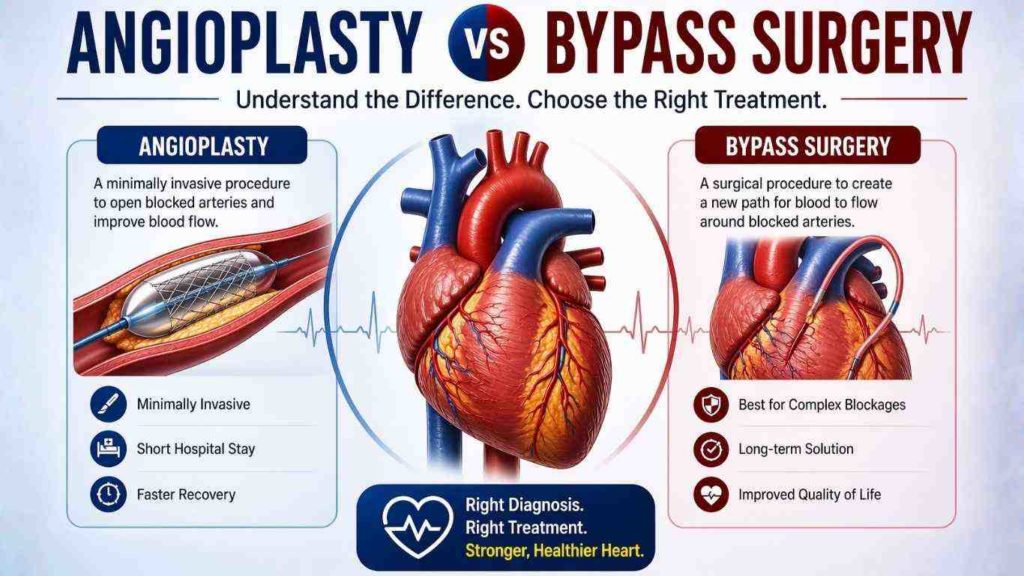
Heart problems are becoming common in people of all ages, especially in cities like Kadapa where lifestyle changes, stress, and unhealthy habits are increasing.
When doctors say there is a block in the heart, most patients hear two treatment options:
- Angioplasty
- Bypass Surgery
This creates confusion. Many people think one is always better than the other—but that’s not true.
Both angioplasty and bypass surgery are done for the same reason:
To restore proper blood flow to the heart.
Why are these procedures commonly needed?
Your heart needs a continuous supply of oxygen-rich blood. This blood flows through arteries. Over time, these arteries can become narrow or blocked due to:
- Cholesterol buildup
- High blood pressure
- Diabetes
- Smoking
- Lack of physical activity
When the blockage becomes serious, it can lead to chest pain or even a heart attack. At this stage, medicines alone are not enough. In such situations, doctors recommend choosing between angioplasty vs bypass surgery, depending on the severity of the blockage.
In Kadapa, many patients delay treatment due to confusion or fear. That delay is often more dangerous than the disease itself.
What is Angioplasty?
Angioplasty is a non-surgical procedure used to open blocked heart arteries.
It is usually done without making any large cuts in the body. A thin tube is inserted through a blood vessel, often from the wrist or groin, and guided to the blocked artery.
A small balloon is inflated to open the blockage, and a stent is placed to keep the artery open.
In simple terms, angioplasty is like fixing a blocked pipe from inside without breaking it.
Key features of Angioplasty:
- No major surgery involved
- Short hospital stay (1–3 days)
- Faster recovery compared to surgery
- Minimal pain
Angioplasty is often recommended for patients who have limited or less complex blockages.
It doesn’t work for every situation. Picking it just because it seems easier can lead to the wrong treatment decision.
What is Bypass Surgery?
Bypass surgery is a major surgical procedure used when blockages are severe or multiple.
In this surgery, doctors take a healthy blood vessel from another part of the body and create a new pathway for blood to flow around the blocked artery.
Instead of fixing the blockage directly, bypass surgery creates a completely new route for blood flow.
Think of it like this:
If a road is completely blocked, instead of repairing it, a new road is built around it.
Key features of Bypass Surgery
- It is a major operation
- Requires a longer hospital stay
- Recovery may take several weeks
- Provides a long-term solution for serious conditions
Bypass surgery is often the safer choice when the heart condition is complex.
Key Differences Between Angioplasty and Bypass Surgery
Understanding the difference clearly will help you avoid wrong decisions.
Here are the main differences explained simply:
- Procedure type
Angioplasty is non-surgical, while bypass is a major surgery - Recovery time
Angioplasty allows quick recovery, bypass takes longer - Severity of condition
Angioplasty is used for simpler cases, bypass for complex cases - Hospital stay
Short stay for angioplasty, longer stay for bypass - Long-term outcome
Bypass is often more durable in severe conditions
The biggest mistake patients make is choosing based on comfort instead of medical need.
In Kadapa, proper evaluation by a specialist like Dr. Sravan Kumar Nandaluru helps in making the right decision.
Life After Surgery – What to Expect
Many patients focus only on the procedure but ignore what happens after.
The truth is, your lifestyle after treatment matters more than the treatment itself.
After Angioplasty Surgery:
Recovery is usually quick. Most patients can return to normal routine within a few days. However, lifestyle changes are still necessary.
After Bypass Surgery:
Recovery takes longer. The body needs time to heal from surgery. Patients may need a few weeks before returning to regular activities.
In Both Cases,patients must:
- Follow doctor’s advice strictly
- Take prescribed medications regularly
- Attend follow-up checkups
- Maintain a healthy lifestyle
If you ignore these, even the best treatment can fail.
Care After Surgery – Do’s and Don’ts
This is where most patients go wrong. They think treatment is the end—it’s actually the beginning.
Do’s:
- Eat a heart-healthy diet (low oil, low salt)
- Exercise regularly (as advised by doctor)
- Take medicines on time
- Monitor BP and sugar levels
- Attend regular checkups
Dont’s:
- Don’t smoke or consume alcohol
- Don’t skip medications
- Don’t ignore symptoms
- Don’t return to unhealthy lifestyle
- Don’t self-medicate
Two Real Examples:- A patient who follows diet and medicines properly can live a normal life for years
- A patient who ignores advice may face repeat blockage within months
Your recovery depends more on your discipline than the procedure.
Why Choose Vedanta Hospital for Heart Treatment?
In Kadapa, choosing the right hospital is critical. Not all hospitals offer the same level of care.
Vedanta Hospital stands out because of:
- Experienced cardiology team
- Advanced diagnostic facilities
- Emergency cardiac care
- Patient-focused treatment approach
Most importantly, treatment decisions are based on actual patient condition, not assumptions.
Expert Cardiac Care in Kadapa
Heart treatment should always be guided by an experienced specialist.
At Vedanta Hospital, patients are treated under the care of Dr. Sravan Kumar Nandaluru
He evaluates:
- ECG reports
- Angiogram results
- Overall patient condition
Only after proper analysis is the treatment recommended.
This reduces risk and improves long-term outcomes.
When Should You Consult a Doctor?
Many patients wait too long before seeking help.
You should consult immediately if you experience:
- Chest pain that continues for more than a few minutes
- Shortness of breath
- Pain in arm, neck, or jaw
- Sudden sweating or dizziness
Neglecting these warning signs may result in dangerous complications.
Final Conclusion
Both angioplasty vs bypass surgery are effective treatments—but only when used correctly.
- Angioplasty is best for simple blockages
- Bypass surgery is best for complex conditions
The right treatment is not what feels easy
It is what your heart condition demands